
WHAT WE DO
Delivering a proven, life-saving model for health equity
Designed in collaboration with communities and government partners and grounded in scientific evidence, Pivot’s model is not only saving lives today, but strengthening the systems that will sustain them tomorrow.
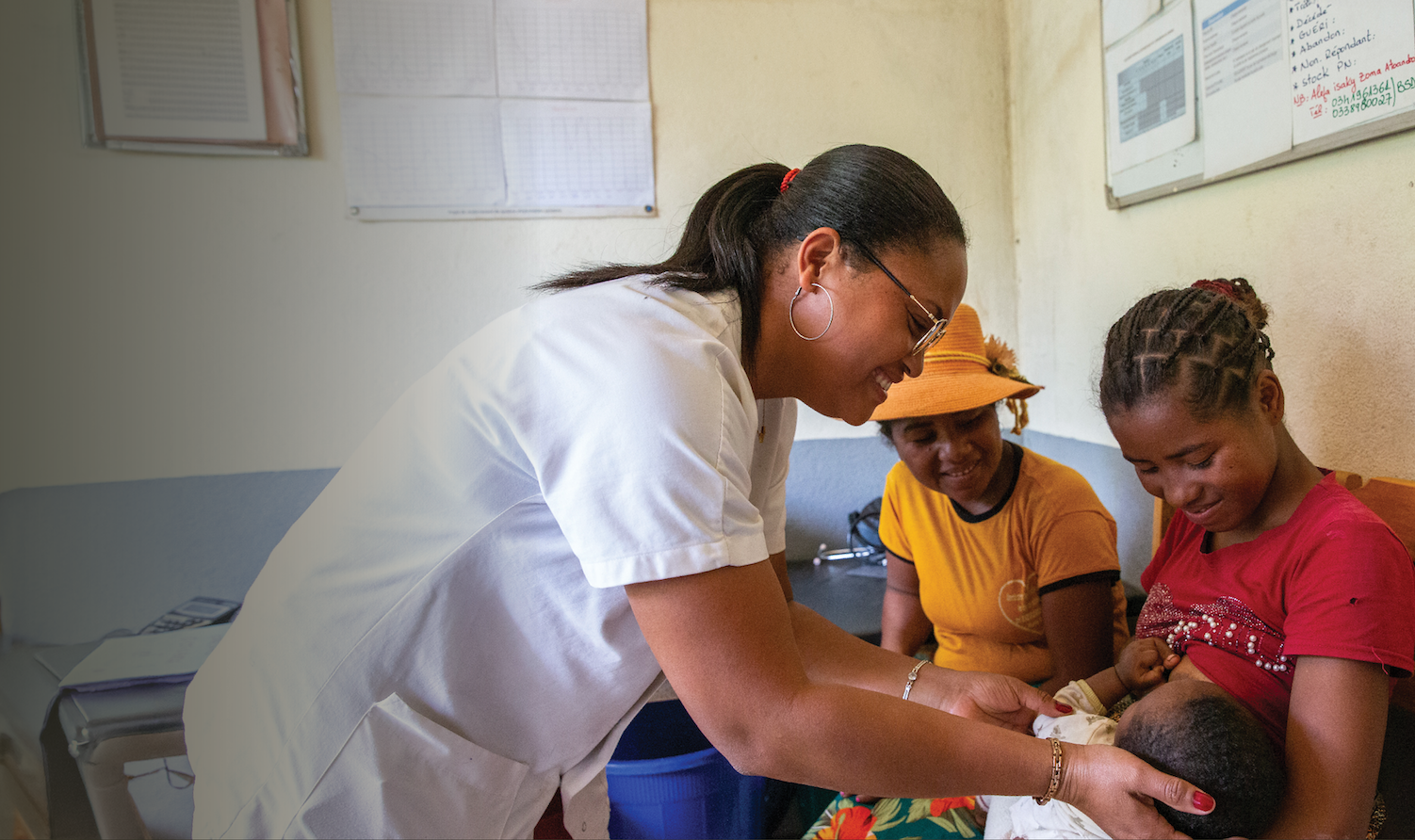


Partnering with government
Pivot does not build parallel systems – we strengthen those already reaching people across Madagascar.
In partnership with Madagascar’s Ministry of Public Health, Pivot develops solutions that improve access, quality, and equity of care within the systems that already exist – making proven approaches easier to scale.


How our integrated approach is saving lives, transforming health systems, and catalyzing global change:

From Community Health Workers to referral hospitals, Pivot strengthens every level of the public health system – ensuring patients can access high quality care when and where they need it.

Community Health
Care that begins where people live
We ensure Community Health Workers are trained, equipped, and continuously supported, ensuring families can access essential care close to home when they need it most.
Primary Care Centers
Making essential care dependable
We strengthen rural primary health centers through investments in staffing, infrastructure, and quality of care, with a programmatic focus on women and children.
Referral Hospitals
Specialized care without barriers
We support public hospitals to provide reliable, high-quality care for patients with severe illness, injury or complications.


1. Access to Care
No one should be denied care because they cannot afford it – or because they live too far away from it. Pivot’s model is designed to overcome the financial, geographic, and social barriers that keep families from getting care. We remove user fees to bring essential services closer to communities through Community Health Workers, and build maternal waiting homes where women can safely stay near health centers while awaiting labor. We also provide wraparound social support to the most vulnerable patients and families.

2. Health Workforce
A health system is only as strong as the people who are there to power it. We invest in healthcare personnel – from Community Health Workers serving remote communities to clinicians working in rural health centers and hospitals – ensuring they are deployed where they are needed most, equipped to succeed, and motivated to stay. Working alongside the Ministry of Public Health, we fill critical staffing gaps, strengthen clinical skills through training and mentorship, and advocate for fair compensation and better workforce planning.

3. Facility Infrastructure
Patients deserve to receive care in safe, dignified spaces. We invest in public health infrastructure across all levels of care – from community-led construction of community health sites to major renovations and expansions at primary and secondary care facilities. By equipping these spaces with reliable water, clean energy, and climate-resilient upgrades, we ensure health centers can withstand environmental crises and consistently provide high-quality essential care.

4. Medicines, Supply Chain, & Diagnostic Capacity
Effective treatment begins with accurate diagnosis. We strengthen diagnostic and laboratory capacity – from malaria rapid diagnostic tests used by Community Health Workers to laboratory services in referral hospitals – so health workers can identify illness and provide the right care. We also strengthen supply chains for medicines and medical supplies, improving availability from national warehouses to the last mile. Our research helps identify emerging diagnostic needs and anticipate future disease burden, informing health system planning.

5. Health Management Information Systems & Mobile Technology
BBetter data leads to better decisions. We strengthen health information systems and equip frontline health workers with digital tools that improve patient care, reporting, and follow-up. By connecting information from communities, health facilities, and national systems, we help health leaders identify gaps, respond to emerging challenges, and plan for future needs. These investments also create the foundation for research that improves healthcare delivery and population health.

6. National Policy & Leadership
Sustainable change happens when proven solutions are adopted and scaled across the public health system. After more than a decade of frontline implementation and research, Pivot brings operational expertise, rigorous evidence, and trusted government partnerships to national decision-making. From health financing to community health policy, we help translate what works in practice into policies and strategies that strengthen healthcare and save lives across Madagascar.


Closing the know-do gap
At Pivot, science is not an afterthought or a tool for validation – it is built into the work itself.
Service delivery, data systems, and scientific inquiry come together in a continuous cycle of learning that strengthens programs and improves health outcomes. But improving our own work is only part of the story. Through integrated processes, Pivot’s multidisciplinary research generates new insights for Madagascar and for the world.


Key areas of exploration
We bridge data and delivery through continuous scientific inquiry.
By embedding rigorous study into these core disciplines, we solve immediate operational challenges in Madagascar while advancing the cutting edge of global implementation science.


1. Biological data
Biological samples, including dried blood spots and nasal swabs, collected through household surveys and facility-based research, generate critical insights into disease seroprevalence, transmission dynamics, and pathogen metagenomics.
FIGURE: Garchitorena, et al. Morbidity and mortality burden of COVID-19 in rural Madagascar: results from a longitudinal cohort and nested seroprevalence study. Int J Epidemiol 52(6):1745-1755 (2023).


2. Health information systems data
By strengthening the national health information system (DHIS2) and developing innovative electronic tools for CHWs and health facilities, Pivot strengthens both data collection and the systems that transform data into actionable information. This enables both the Ministry of Health and Pivot to better monitor health outcomes, health system utilization, and health system performance. Real-time patient visit data and monthly aggregated diagnosis data support analyses of infectious disease dynamics, forecasting of medication and supply needs, and assessment of how program implementation influences healthcare utilization.
FIGURE: Razafinjato, et al. Evaluation of a novel approach to community health care delivery in Ifanadiana District, Madagascar. PLOS Glob Public Health 4(3): e0002888 (2024).


3. Satellite imaging data
Remotely sensed environmental dynamics from high resolution satellite imagery of Vatovavy Region are used to understand localized predictors of disease dynamics, factors driving land use, and the relationship between environment and behavior.
FIGURE: Randriamihaja, et al. Monitoring individual rice field flooding dynamics over a large scale to improve mosquito surveillance and control. Malaria J 24(1):107 (2025).


4. System readiness data
Health systems data on service availability, quality of care, and system functioning provide evidence of change in systems functioning and allow for early intervention to address gaps. These data also allow us to track health system resilience in the face of external shocks, such as a global pandemic or a cyclone.
FIGURE: Evans, et al. Designing and Evaluating a Health System Resilient to Extreme Weather Events in Rural Madagascar. Annals of Global Health, 91(1), p. 40 (2025).


5. Environmental data
Publicly available data from global databases on climate and environment provide information on conditions across Vatovavy Region, informing analyses of climate-informed diseases. Data include temperature, wind speed, rainfall, and elevation.
FIGURE: Evans, et al. Increasing the resolution of malaria early warning systems for use by local health actors. Malar J 24, 30 (2025).


6. Population-representative data
In collaboration with the Madagascar National Institute of Statistics and Harvard Medical School, Pivot periodically collects data from nearly 5,000 households across Vatovavy Region. Using a questionnaire based on the Demographic and Health Survey, household residents answer questions about their health, wellbeing, and health-seeking behavior as well as demographics, education, and socioeconomic status.
FIGURE: Garchitorena, et al. Changes in child mortality and population health following 10 years of health systems strengthening in rural Madagascar: A longitudinal cohort study. PLoS Med 22(10): e1004549 (2025).


7. Geographical data
Pivot has led the mapping of nearly one and a half million buildings and 197,000 km of footpaths across eight districts of Madagascar, for a total area of about 30,200 km2. The data provide the backbone for analyses of geographic accessibility of healthcare services, optimal routes for the movement of CHWs and medical supplies, and the spatial distribution of disease.
FIGURE: Ihantamalala, et al. Improving geographical accessibility modeling for operational use by local health actors. Int J Health Geogr 19, 27 (2020).
Featured PUBLICATION
July 22, 2025
Michelle Evans, et al.
Annals of Global Health
